How Long Does It Take to Get a Florida Insurance License?
The Real Timeline, Start to Finish
When you’re changing careers or starting fresh in insurance, one of the first questions you ask is:
“How long will it actually take me to get my Florida insurance license?”
The honest answer is: it depends on the license type and your schedule. But if you break the process into clear steps, you can estimate a realistic timeline and avoid surprises.
In this guide, we’ll walk through the major stages — from choosing a license and enrolling in a course to passing the exam and getting your license issued — so you can plan your next few weeks or months with confidence.
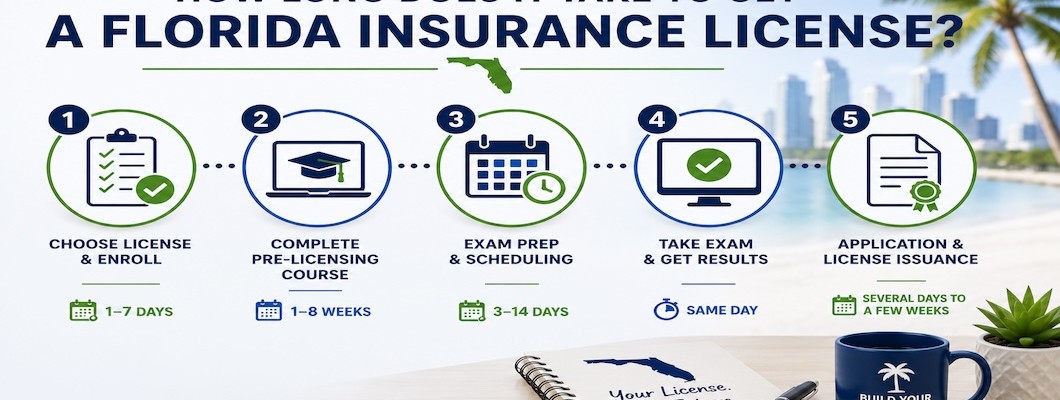
Step 1: Choose Your License and Course (1–7 days)
Before anything else, you need to decide which license you’re going for. Common Florida options include:
- 2-20 General Lines (full P&C)
- 20-44 Personal Lines
- 4-40 Customer Representative
- 2-15 (215) Life, Health & Variable Annuities
- 2-14 Life (including Variable Annuities)
- 2-40 (240) Health
- 6-20 All-Lines Adjuster
This step can be quick if:
- A job posting clearly states the license required.
- You’ve already read comparison guides and know which path fits you.
If you’re still deciding, expect to spend a few days:
- Researching the difference between licenses.
- Talking with potential employers or mentors.
- Confirming which license lines up with the role you want.
Once you know the license code, you can choose a Florida approved pre-licensing course and enroll. You can start the the same day you register.
Step 2: Complete Your Pre-Licensing Course (1–8 weeks)
The biggest variable in your timeline is how long it takes you to finish the course.
Each license has different education-hour requirements and course lengths. For example (general patterns, not official numbers):
- A broad license like 2-20 General Lines or 2-15 Life & Health typically involves more hours and more content.
- More focused licenses like 20-44, 4-40, or 2-40 usually involve fewer hours.
Your completion speed depends on:
- Format: Self-paced online vs fixed-schedule classroom.
- Schedule: How many hours per week you can realistically study.
- Background: Whether you’re totally new to insurance or have experience.
Rough self-paced estimates (online):
- Aggressive pace (full-time focus): 1–2 weeks for many licenses.
- Moderate pace (working full-time): 3–6 weeks of evenings/weekends.
- Light pace (very busy schedule): 6–8+ weeks.
Many students underestimate how much time they’ll need. It’s better to overestimate and finish early than to feel rushed right before your exam. You can see examples of Florida-approved online courses at OLT’s Florida pre-licensing catalog.
Step 3: Exam Prep and Scheduling (3–14 days)
Most Florida insurance licenses require passing a state exam after your course.
Once you’ve completed your pre-licensing requirements, you’ll need to:
-
Review and reinforce
Spend several days:- Re-reading tricky chapters.
- Taking practice exams.
- Focusing on weak areas your course identifies.
-
Schedule the exam
You’ll book an appointment with the state’s testing vendor. Availability can vary by location and season, but many students can find an exam slot within 3–10 days, especially if they’re flexible on time and test center.
A common pattern:
- 3–7 days of focused review after finishing the course.
- 3–10 days to get a test appointment.
Many students overlap these: they schedule the exam first, then study intensely leading up to that date.
Step 4: Taking the Exam and Getting Results (Same Day)
When you sit for your Florida insurance exam:
- You’ll complete a computer-based multiple-choice test at a testing center.
- At the end, you’ll usually receive a pass/fail result immediately.
If you pass:
- You move on to the application and licensing steps.
If you don’t pass on the first try:
- You can usually retake the exam, subject to any waiting periods or additional fees set by the testing vendor and FLDFS.
- Your overall timeline then depends on how quickly you reschedule and review.
Many students do pass on their first attempt when they’ve used a solid Florida-specific course and fully worked through practice questions.
Step 5: Application, Fingerprints, and License Issuance (Several days to a few weeks)
After you pass the exam, you must complete the state application and background steps.
This can include:
- Submitting an online application through the Florida DFS portal.
- Paying any required state fees.
- Completing fingerprinting through an approved vendor (if you haven’t already).
- Responding to any requests for additional documentation about your background.
How long this takes can vary:
- If your background is straightforward and your paperwork is complete, processing can be relatively quick.
- If the DFS needs to review criminal or financial history, it may take longer and require more documentation.
Your license is typically issued once:
- The application is complete.
- Your fingerprints and background checks have been processed.
- The DFS is satisfied that you meet all requirements.
Putting It All Together: Sample Timelines
Here are a few rough sample timelines to illustrate how it can look in real life.
Scenario 1: Full-time focus, simple background
- Week 1: Choose license, enroll, and begin course.
- Weeks 1–2: Complete an online course at a full-time pace.
- Week 3: Review and take multiple practice exams; schedule state exam.
- End of Week 3: Take exam and pass.
- Weeks 4–5: Complete application, fingerprints, and await license issuance.
Total: About 4–6 weeks from zero to licensed.
Scenario 2: Working full-time, studying evenings/weekends
- Week 1: Choose license, enroll in online course.
- Weeks 1–4: Study a few evenings and weekends; complete course in 3–4 weeks.
- Week 5: Focused review and practice exams; schedule state exam.
- End of Week 5 or Week 6: Take exam and pass.
- Weeks 6–8: Complete application, background, and license issuance.
Factors That Can Speed You Up or Slow You Down
You can shorten or lengthen your timeline based on:
- Study consistency: Small, regular study blocks beat cramming once a week.
- Course choice: A well-structured, Florida-specific course can cut down confusion and re-study time.
- Scheduling flexibility: Being open to daytime or weekday exam slots can get you in sooner.
- Background complexity: Prior legal or financial issues can extend processing time.
The one factor you control the most is how steadily you work through your course and practice questions.
Final Thoughts: Plan Backwards From Your Goal Date
To build a realistic plan, start with your target date and work backwards:
- Decide when you’d like to be licensed or starting your new job.
- Subtract time for:
- Application and background (several days to a few weeks).
- Exam scheduling and prep (1–2 weeks).
- Course completion (anywhere from 1–8+ weeks, depending on your schedule).
- The date you land on is when you should enroll in your course and start studying.
With clear expectations and a steady pace, many Florida students go from “just researching” to “fully licensed” in a couple of months or less. The key is to choose the right license, commit to your study schedule, and move step-by-step through the process without long gaps in between. ENROLL TODAY AT OLT!